On September 29, 2026, Wilfrid Laurier University took two of its campus buildings off BACnet broadcast forwarding. Within a minute of each building’s BACnet Broadcast Management Device, or BBMD, being switched off, the forwarded broadcasts arriving on that building’s subnet, which had been running at more than 11,000 an hour, fell to zero, and they have not returned in any hour since. The effect runs in both directions: the two buildings no longer receive the broadcasts forwarded to them from elsewhere on campus, and the subnets that used to receive their broadcasts no longer do. In the week to October 7, the buildings were spared roughly 3.7 million broadcasts, the front end’s reads of the larger building’s controllers became markedly faster with far fewer timeouts, and the change was made in stages, with each step measured and reversible, without replacing a single controller. This article explains why broadcast forwarding becomes a liability on any growing BACnet network, from a university campus to a single office tower, why the problem is getting worse rather than better, and what Laurier’s results show about the alternative.
How a BACnet Network Finds a Device
Every BACnet device is identified by a device instance number that must be unique across the whole internetwork. Before a front end, the operator workstation and server that read and display a building’s points, can read a value or populate a graphic, it usually has to learn where the device with that instance number lives, unless its address was entered by hand. BACnet has answered that question the same way since ANSI/ASHRAE Standard 135 was first published in 1995: the front end broadcasts a Who-Is, each matching device replies with an I-Am, and the front end takes the device’s address from the source of that reply. A ranged Who-Is asks only for devices within a range of instance numbers, while an unranged Who-Is asks every device that hears it to answer; the range decides who replies, but it has no bearing on how far the request travels.
Who-Is is typically the largest share of broadcast traffic, as it was at Laurier, but it is far from the only one. I-Am replies are frequently broadcast as well, often globally, alongside Who-Has and I-Have, which locate objects rather than devices (The Other Half of Discovery), the router messages Who-Is-Router-To-Network and I-Am-Router-To-Network, by which devices find routers and routers announce themselves, time synchronization, unsubscribed change-of-value notifications, event notifications, and vendors’ private transfers. In the smaller of the two Laurier buildings, just over 91 percent of the forwarded traffic was Who-Is and about 7 percent was I-Am, and taking the building off forwarding removed all of it at once, whatever its type.
IP Routers, BACnet Routers and How Far a Broadcast Travels
Two kinds of router matter here, and they are easily confused. An IP router joins IP subnets and, in practice, never passes a broadcast from one subnet to another, because containing broadcasts is one of the principles that keeps a large IP network healthy. A BACnet router joins BACnet networks, each with its own network number, such as a BACnet/IP network and the MS/TP trunks behind it. MS/TP (master-slave/token-passing) trunks are the twisted-pair serial buses that connect many field controllers, and a BACnet router forwards BACnet messages between them and the IP side according to the rules of the standard, including some broadcasts.
Which broadcasts a BACnet router forwards depends on the destination fields in the message’s network header. A local broadcast names no destination network and stays on the network it was sent on. A remote broadcast names one destination network and is broadcast on that network alone. A global broadcast carries the destination network number X’FFFF’ (65535) and, in the standard’s words, “is sent to all networks through all routers,” so every BACnet router that receives one must rebroadcast it on each directly connected network except the one it came from, until its hop count, which limits how many routers a message may cross, runs out (Clause 6.3.2).
Because IP routers stop broadcasts, BACnet/IP needed its own way across them. Annex J, added to the standard in 1999, defines a BACnet/IP network as one or more IP subnets that share a single BACnet network number, with BACnet Broadcast Management Devices carrying broadcasts between them. A BBMD sends a forwarded copy of every broadcast on its subnet to each BBMD listed in its Broadcast Distribution Table, which rebroadcasts it on its own subnet, and to any foreign device registered with it (a device elsewhere that has registered to receive the subnet’s broadcasts), without looking at whether the message inside is local, remote or global. A Who-Is sent in one building, or on one floor, is therefore heard everywhere the BBMDs reach, which is what allows a front end to find any device and also what makes the traffic grow with every subnet added.
What matters, then, is not the BBMD itself but the size of the broadcast domain, the set of devices that every broadcast reaches. Two /24 subnets of 256 addresses each joined by BBMDs, and a single /23 subnet of 512 addresses with no BBMD at all, are for BACnet essentially the same network: Annex J treats each as one BACnet/IP network, and in each a Who-Is sent anywhere reaches every device in both halves, the only difference being that the BBMDs add a step, and a device that can fail, to every delivery. A site that has never configured a BBMD is therefore not safe from the problem. Some sites run their building automation on a single large subnet, a /16 of more than 65,000 addresses for example, and keep adding devices to it, and there every broadcast, from ARP requests to Who-Is, reaches every device at Layer 2 with no BBMD involved. Dividing such a network into smaller subnets shrinks its broadcast domains only until BBMDs are added to join them back together, which is why the remedy has to divide the network and remove the forwarding at the same time, as the multi-VLAN mode described below is designed to do.
Nor does a BACnet router protect the devices behind it, as One IP from IT and Device Address Proxying and BBMD Caching explained. It keeps local broadcasts on their own side, but it must pass every global broadcast onto every MS/TP trunk it serves. The only exception is a router using Device Address Proxying, added to the standard in 2024, which answers Who-Is for the devices behind it instead of passing the request on, and even then only Who-Is is held back; the older slave proxy function answers only for slave devices and still passes the Who-Is to the trunk. On an MS/TP trunk, a controller may start a transmission only while it holds the token and every broadcast frame reaches every device, so each global Who-Is takes its turn on the wire beside the controllers’ own traffic. Beyond Broadcast described MS/TP devices as shielded by their routers from most IP-side broadcast traffic, which holds for local broadcasts but not for the global form, and the global form is what front ends, integration tools and misconfigured controllers commonly send. In the smaller Laurier building’s captures, all 454 forwarded Who-Is requests in one session, and 611 of 626 in another, were global, and so were the forwarded I-Am replies.
Both Directions at Once
Forwarding works in both directions, and so does its cost. On a fully meshed network, every subnet receives the broadcasts of every other subnet and every broadcast that starts on a subnet is copied to all the others, so each subnet added is both a new source of traffic and a new destination for everyone else’s. Every device must receive each broadcast that arrives and, unless it has to answer, discard it. As the load rises, the symptoms appear gradually and are often hard to trace to their cause: device discovery becomes sporadic and slow, latency and timeouts increase, and communication errors flap on and off across the graphics.
The front end has the hardest position of all, because its BBMD must exchange broadcasts with every subnet whose devices it needs to find, and its BACnet driver must process every forwarded frame while it polls, trends and handles alarms. It is a source as well as a destination, since a front end whose BACnet driver restarts, for whatever reason, rediscovers and re-reads the site at once, and on a forwarded network the discovery broadcasts in that burst reach every subnet.
The usual mitigation, which the standard has explicitly allowed since a 2009 addendum, is to prune the Broadcast Distribution Tables so that each BBMD shares broadcasts only with the front end’s BBMD. That stops subnets from receiving one another’s broadcasts, but not the front end’s own, which matters wherever the front end does much of the asking. The asymmetric tables are easy to get wrong and hard to audit, devices on different subnets can no longer find one another, and the front end gains nothing, because it must still exchange broadcasts with every subnet.
A Fundamental Problem, and One That Is Getting Worse
Some of the broadcast volume on any site can be traced to a particular device or setting and corrected, and it should be. What no amount of correction changes is that forwarding carries every broadcast, from every source, to every subnet that shares it, so the next fault reaches everywhere as quickly as the last one did. The trend is also running in one direction. As MS/TP controllers reach the end of their service lives and are replaced with BACnet/IP devices, as Beyond Broadcast described, each one leaves the shelter its router gave it from local broadcasts and joins the broadcast domain in full. A site that copes at 10 or 20 percent BACnet/IP will find the situation very different at 50 percent, and some sites are already showing the symptoms well before that, which means the runway is shorter than the share of IP devices suggests.
Much of the industry’s response has been analytics, the BSA-1000 analyzer in the BACsync product line among them. Capture analysis returns a health score and a ranked list of problems, and that is genuinely useful for diagnosis, as A Diagnosis Is Not a Remedy set out. A list, however, is not a remedy, because it hands the operator a queue of work, it shows only what one capture could see, which on an ordinary switch port is the broadcast traffic reaching that port and none of the unicast traffic between other devices, and it is out of date as soon as the next device is installed. What the market needs is prevention that is built into the architecture, rather than resting on the diligence of whoever last read the report.
Nobody Should Be Able to Bring a Building Automation System to Its Knees
A building automation system depends every day on hundreds or thousands of devices behaving correctly, and a forwarded network has no defence when one of them does not. A controller installed with a default instance number, a firmware defect that sends Who-Is in a tight loop, an integration tool set to rediscover the site every few seconds, or a front end that restarts and rediscovers everything at once can each begin quietly, and forwarding carries every one of them everywhere. Hoping that every device will behave correctly, indefinitely, is not a strategy.
The principle behind the BSP-1000, a platform of agents that answer discovery on each subnet so that broadcasts no longer need to be forwarded, is that nobody should ever be able to arrive on site, make a change or add a device, and bring the system to its knees. Part of that protection is architectural: once a building, a floor or even a single device’s VLAN no longer depends on forwarding, nothing rebroadcasts its broadcasts to the rest of the site, so a broadcast storm that begins there is no longer delivered to every other subnet. The rest is enforced by the platform:
- Only approved devices are answered for. A device installed with a default or conflicting instance number is never handed out to front ends by the platform until it has been approved.
- Duplicate device instances are refused. When a second device claims an instance number already in use, the platform keeps the first, refuses the second, and raises a critical finding that names the instance and both addresses.
- Floods are flagged, and a Who-Is flood is never amplified. Sources that send discovery requests at abnormal rates are flagged, and a source flooding the platform with Who-Is requests is answered at most once a minute.
- Problems are raised as findings, with alerts sent according to the site’s own rules, so the operator learns of a problem from the platform rather than from its symptoms.
A device can still misbehave on its own wire, as it can on any network, but its broadcasts are no longer rebroadcast to the rest of the site, and that protection comes from the design of the network rather than from vigilance.
Micro-Segmentation Without a BBMD on Every Subnet
Micro-segmentation, the practice of placing a single device, or a small group of devices, on a network of its own, is increasingly what reliability and security reviews ask of operational technology, because whatever goes wrong on that network stays there. A virtual LAN, or VLAN, makes this inexpensive at the switch: one physical network carries many logical ones, each its own broadcast domain and usually its own IP subnet. For BACnet, however, segmentation has always come at a price, because a device alone on its own subnet can no longer be found by broadcast.
Under Annex J, the way to make that device discoverable again is a BBMD on its subnet, listed in the Broadcast Distribution Tables of the other BBMDs. Consider a building whose 40 BACnet/IP controllers are each to be given a VLAN of their own: forwarding would need 40 more BBMDs, each a controller set up for the role or a device added for it, and on a fully meshed network 40 tables of 40 entries each, some 1,600 entries to keep consistent and every one a chance for error. Foreign device registration avoids the extra BBMD only for devices that support registering, and it still delivers every forwarded broadcast to them. At the end of all that work, each isolated device would still receive every broadcast forwarded from everywhere else, because a BBMD forwards whatever arrives, with no means of limiting its rate, of approving the devices it serves, or of deciding which broadcasts may enter or leave the subnet. The devices would be separated on paper and joined again by every broadcast.
The BSP-1000 turns that into a matter of configuration. In multi-VLAN mode, one agent connects to many VLANs at once through a single tagged switch port, an IEEE 802.1Q trunk, and answers discovery on each of them without forwarding anything from one VLAN to another, so a device can be given a VLAN of its own with no BBMD, no table entries and no hardware beyond the one agent. With the platform’s access rules tightened for those VLANs, only approved devices are answered for, a source flooding the platform with Who-Is requests is flagged and answered at most once a minute, and nothing from the rest of the site is rebroadcast onto the isolated VLAN. The platform, rather than a forwarding table, decides which devices can be found across each VLAN’s boundary, and a fault on that VLAN stays there. Segmentation down to a single device, which forwarding made impractical, becomes practical at the scale of a whole site.
Laurier’s Approach: Measured, Staged and Reversible
What distinguishes Laurier’s deployment is the way it was carried out as much as the result. The controls team in Laurier’s Facilities Operations made the change early, on live buildings and in the open, in stages, with each step measured and each BBMD’s table kept so that the change could be undone.
Prior to the upgrades, communication instability at these two buildings was so common that operators were accustomed to seeing COMM errors on the front end. The prevailing sentiment was, “Give it five minutes and it will sort itself out.” This uncertainty underscored the need for a more reliable, sustainable solution.
— Chris Witmer, Controls Technician, Wilfrid Laurier Facilities Operations (Facilities and Asset Management)
The BSP-1000 agents support that kind of rollout through operating modes that match its stages. In passive mode, an agent discovers and reads the devices on its own subnet and on the networks behind its routers but answers nothing, recording the building’s normal behaviour before anything changes. In migration mode, an agent works alongside the existing BBMDs and leaves the forwarding mesh as it is, so that managed and legacy devices keep communicating throughout the transition. In active mode, the agents answer discovery for the building’s devices wherever they are asked for, which is what allows the building’s BBMD to be switched off.
Throughout, the front end kept reading the buildings’ controllers as it always had, by ordinary routed unicast that never needed a BBMD, and apart from switching off the BBMD function, nothing on the controllers or the front end was changed. If an agent stops, only new discovery requests made on its own subnet go unanswered while existing communication carries on, and the BBMD can be switched back on from its saved table.
The rollout is designed as a sequence: a passive period to record each building’s baseline, a review of what its BBMD forwards so that the team knows what will stop, front-end captures before and after, and only then the change to active mode and the switch-off of the BBMD’s forwarding, with its Broadcast Distribution Table saved so that it can be restored. At Laurier, the smaller building’s agent took up its new mode eleven seconds after it was set on the server, with no restart and no site visit, and its BBMD was switched off immediately afterward. The final step, once a building has proven itself over time, is to remove its BBMD configuration permanently and to remove it from the other BBMDs’ tables.
September 29, 2026
The change itself took place over a single afternoon and evening, and the agents recorded every hour of it on each building’s own wire.
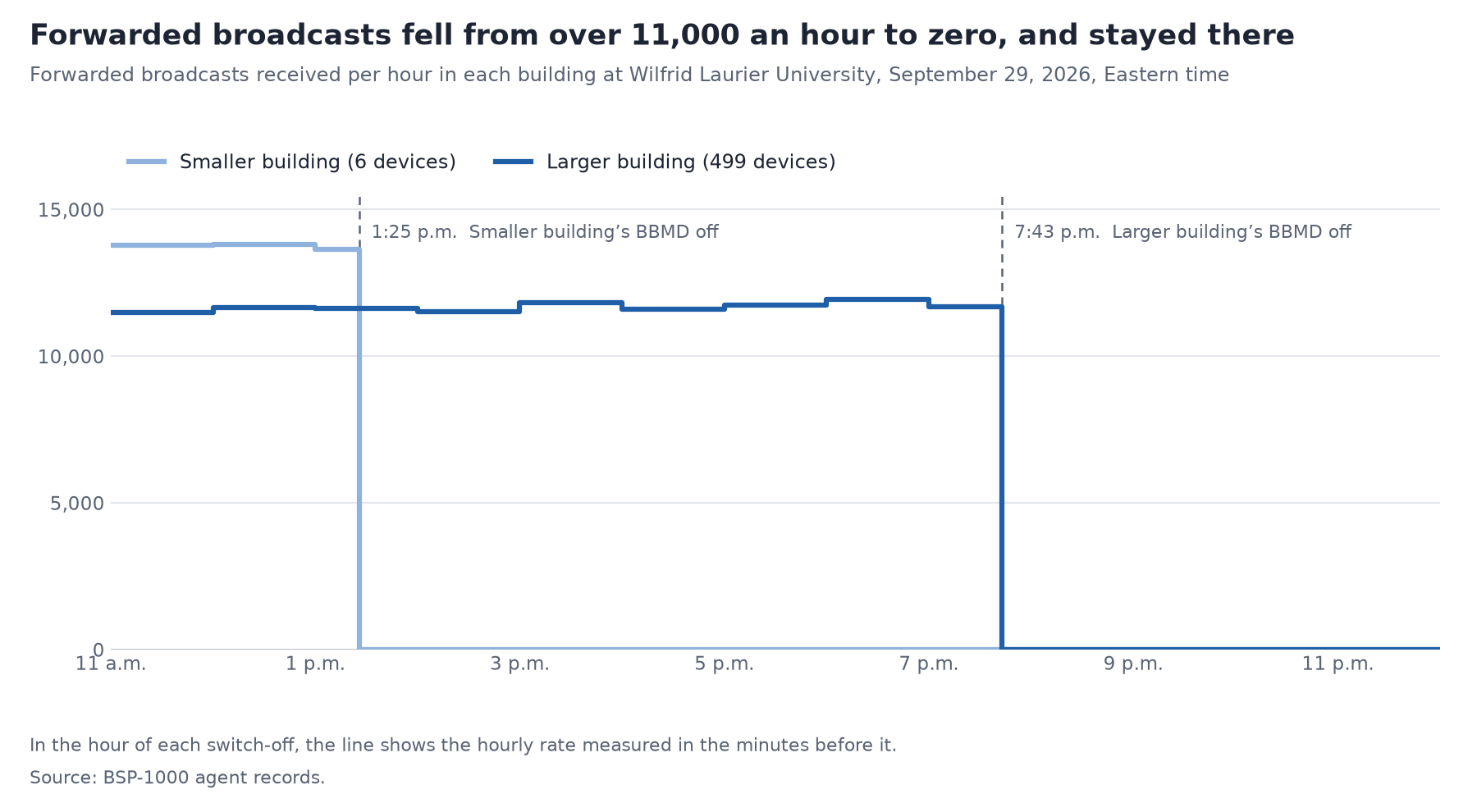
The smaller building’s BBMD was switched off at 1:25 p.m. and the larger building’s at 7:43 p.m. In the last minutes before it, forwarded broadcasts were still arriving in the larger building at 170 to 212 a minute; from 7:43 p.m. the count was zero, and in every hour since, neither building’s subnet has received a single forwarded broadcast.
What the Numbers Show
The inbound counts below were recorded hour by hour by the BSP-1000 agents on each building’s own subnet; the outbound figure is calculated from the distribution tables, and the front end’s figures come from two packet captures.
Before the change, the two buildings were receiving close to 25,000 forwarded broadcasts an hour between them, about 600,000 a day. Counting every broadcast arriving on their subnets from other sources, the total fell from about 25,600 an hour to about 1,100 averaged over the week to October 7, a reduction of about 95 percent, while the agents’ own discovery traffic stays on each building’s subnet. In the other direction, the roughly 1,560 broadcasts an hour that the two buildings’ BBMDs used to deliver to the subnets they shared broadcasts with fell to zero, as did the forwarded broadcasts reaching the front end from these buildings. The front end’s own segment, which still exchanges broadcasts with the rest of the campus, has changed little so far, and its relief will come as more buildings move.
Measured against each building’s hourly rate in the 24 hours before the change, the two buildings were spared roughly 3.7 million broadcasts in the week to October 7, every one of which would otherwise have been received by every device on the subnet it arrived on. Because nearly all of the forwarded discovery was global, it also crossed the larger building’s MS/TP trunks, so the week’s total comes to more than 900 million device receptions avoided, which, at the platform’s working estimate of half a millisecond each, is about 125 hours of processor time across the two buildings’ devices.
The front end’s reads improved as well, as captures on the front-end workstation on July 28, before the change, and on October 1, after it, show for 13 of the larger building’s IP controllers and for comparison segments that kept their BBMDs.
| Front-end reads | Larger building, before | Larger building, after | Comparison segments, before | Comparison segments, after |
|---|---|---|---|---|
| Reads that timed out and were sent again | 3.3% (14 of 425) | 0.4% (2 of 475) | 0.28% | 0.15% |
| Time within which 90% of reads were answered | 183 ms | 99 ms | 91 ms | 85 ms |
In the larger building, timed-out reads fell by 88 percent and the 90th-percentile reply time by 46 percent, while on the comparison segments, which started from far lower levels, the same measures fell by 46 percent and 7 percent.
Not Only a Campus Problem
Although this deployment was on a university campus, nothing in it is particular to campuses. An office tower with a subnet on every floor or riser, a hospital, a laboratory building, or a portfolio of buildings joined by BBMDs carries the same forwarding, the same load on its front end and the same exposure to a single misbehaving device, and the high-rise example in One IP from IT shows how a single tower ends up with a BBMD mesh of its own. Any site with more than one BACnet/IP subnet joined by BBMDs is a candidate, and for a site with a small operations team, protection that does not depend on constant attention is worth even more.
What Comes Next
Two buildings are only the beginning, and the same approach can be extended one building at a time, each measured before and after and each reversible until it has proven itself. Every building that moves stops receiving forwarded traffic, stops adding its own, and leaves less for the buildings that remain, all without replacing a single controller.
Frequently Asked Questions
Does a BACnet router keep broadcast traffic away from the MS/TP devices behind it?
It keeps away local broadcasts, but a global broadcast, with the destination network number X’FFFF’, must be passed onto every other network the router serves, including every MS/TP trunk, unless the router uses Device Address Proxying to answer Who-Is itself. An IP router, by contrast, in practice passes no broadcasts between subnets at all, which is why BBMDs exist.
Does any of this apply to a single building, such as an office tower?
Yes, because any site with more than one BACnet/IP subnet joined by BBMDs forwards its broadcasts in exactly the same way, whether the subnets are campus buildings or the floors of one tower.
Can a single BACnet device be placed on a VLAN of its own?
Yes. A BSP-1000 agent in multi-VLAN mode answers discovery on many VLANs through one 802.1Q trunk port without forwarding anything between them, so each device can be isolated without a BBMD or any Broadcast Distribution Table entries, and the platform’s access rules decide which devices are answered for.
Is a site without BBMDs safe from this?
Not necessarily. The problem is the size of the broadcast domain, not the BBMD: a single large subnet delivers every broadcast to every device on it at Layer 2, and a /23 behaves for BACnet much as two /24s joined by BBMDs do. Dividing the network helps only if the pieces are not joined again by forwarding.
What happens to a misbehaving device once its building is off broadcast forwarding?
Its broadcasts are no longer rebroadcast to the rest of the site, and the BSP-1000 raises a finding for it, so the problem is visible without being delivered to every other subnet.
Doesn’t BACnet Secure Connect solve this?
Not on its own. BACnet/SC removes BBMDs within the SC network, but its hub still forwards every broadcast-class message, Who-Is included, to every connected node, as Beyond Broadcast explained, so the discovery load remains.
What did Laurier measure?
Forwarded broadcasts into each of the two buildings fell from more than 11,000 an hour to zero at the moment each BBMD was switched off, and have stayed at zero. The buildings were spared roughly 3.7 million broadcasts in the week to October 7, and the share of the front end’s reads that timed out and had to be sent again fell from 3.3 percent to 0.4 percent.
More information about BACsync and the BSP-1000, including how to get in touch, is available at bacsync.com.
About the Author. Mark Van Weert is the founder and director of Humber Horizons Limited, a building automation and cybersecurity consulting firm based in Ontario, Canada, and the creator of the BACsync product line, including the BSP-1000. A certified engineering technologist (C.E.T.) with thirteen years of experience in BACnet systems integration, a CCNP ENCOR certification, and a background in large campus deployments, Mark specializes in IT/OT convergence and network infrastructure for universities, hospitals, and commercial facilities.
More in this series
- Beyond Broadcast: BACnet Discovery Doesn’t Scale (February 2026)
- Managing Mixed BACnet/IP and BACnet/SC Networks (April 2026)
- Default Posture: BACnet Governance Without IT Dependency (May 2026)
- Device Address Proxying and BBMD Caching (June 2026)
- The Other Half of Discovery: Who-Has and Object Discovery (July 2026)
- A Diagnosis Is Not a Remedy: The Limits of BACnet Analytics (August 2026)
- Diagnose a BACnet Broadcast Storm in 30 Minutes (August 2026)
- One IP from IT: What the Private-Network BACnet Router Solves, and What It Does Not (September 2026)